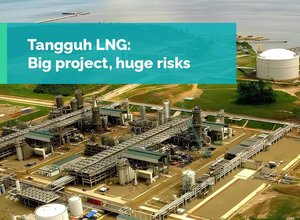
BNP Paribas response to LNG Tangguh Project
[...]
Thank you for reaching out and sharing your concerns about the potential expansion of the Tangguh LNG Project in Indonesia. It is important to us to maintain a high-quality dialogue with civil society and, as always, we value the information you provide.
We have not been approached for this project. In any case, it would not be in line with our sector policy regarding the oil and gas sector, especially as far as Enhanced Gas Recovery (EGR) is concerned. Also, we do not finance LNG export terminals. Indeed, the spirit of our policy is to not encourage the development of the upstream segment of the oil and gas sector.
We would like to take the opportunity of our exchange to provide you with an update on BNP Paribas’ policy regarding the oil and gas sector.
Back in 2017, BNP Paribas was one of the first banks in the world to stop financing unconventional oil and gas projects as well as unconventional hydrocarbon specialists (shale gas, tar sands…). Then, in May 2020, the Group announced a full exit of the financing of the thermal coal value chain – coal mines, coal-fired power plants and coal related infrastructure – by 2030 in OECD and European Union countries, and by 2040 in the rest of the world.
And in 2023, BNP Paribas made strategic decisions based on the various scenarios of the International Energy Agency (IEA) and the analysis of the IPCC, whose latest synthesis report (AR6 Synthesis Report, 2023) reminds that the commissioning of new oil and gas infrastructure is incompatible with limiting global warming to 1.5°C. BNP Paribas announced the Group’s progressive withdrawal from oil and gas exploration and production activities while in parallel launching a large-scale strategy to massively reallocate financing, both for credit and bond financing toward low carbon, primarily renewable, energy production.
To do so, BNP Paribas made several decisions, stated in its updated Oil & Gas Sector Policy :
- BNP Paribas no longer provides financing dedicated to projects for the development of new oil and gas fields regardless of the financing methods.
- BNP Paribas is sharply reducing its participation in general-purpose loans granted to integrated energy companies which are active in the entire value chain from exploration and production.
- Whereas BNP Paribas is the 9th largest bank globally by total balance sheets, its market share in syndicated loans to oil and gas companies is now marginal: it is 0,47% in 2024, down from between 2% and 3% up until 2020 (source: Dealogic).
- When considering the scope of diversified actors, refining/marketing actors, and oil and gas exploration-development actors, in 2024, BNP Paribas participated in only 5 RCF out of 154 (source: Dealogic).
- The group no longer takes part in conventional bonds issuance for companies of the oil and gas sector which are active in exploration and production (diversified players, exploration and production specialists). BNP Paribas did not participate in any bond emission to the oil and gas sector since mid-February 2023 and BNPP AM and Cardif recently aligned with the practices of the BNP Paribas Group and no longer invest in bonds issued on the primary market by such companies. Also, we ranked 1st for green bonds for the whole year of 2024, as we already did in 2023 (source: Dealogic).
In parallel, BNP Paribas is strongly accelerating its financing to low-carbon energy production. By 2030, the group’s target is to reach 90% of low-carbon energies in its financing for energy production with 40 billion euros in credit exposure.
- At the end of Q3 2024, our stock of low-carbon energy production credit exposure accounted for 76% of our total stock of energy production credit exposure, of which 91% (EUR 34.2 billion) for renewable energies. This is an increase by +30% compared to the end of Q3 2022.
- And the remaining 24% of our energy production credit exposure relates to fossil fuels, with our exposure to upstream O&G and refining going down sharply by more than 50% in two years.
- Between September 2022 and September 2024, our exposure had already decreased by 49% for gas and by 56% for oil. Overall, our exposure to fossil fuels (oil, gas, refining, coal) decreased by 51% on the period.
In addition, since 2022, we dedicated 179 billion euros in financing and services to accompany our clients in their transition (an increase by 73% compared with 2023). We are therefore well on track to meet our target to reach 200 billion euros by the end of 2025.
I trust that this clarifies BNP Paribas’ approach and provides you with useful information with regard to the project you mention, and I remain at your disposal should you need any additional information.