Indonesia Weda Bay Industrial Park (IWIP)

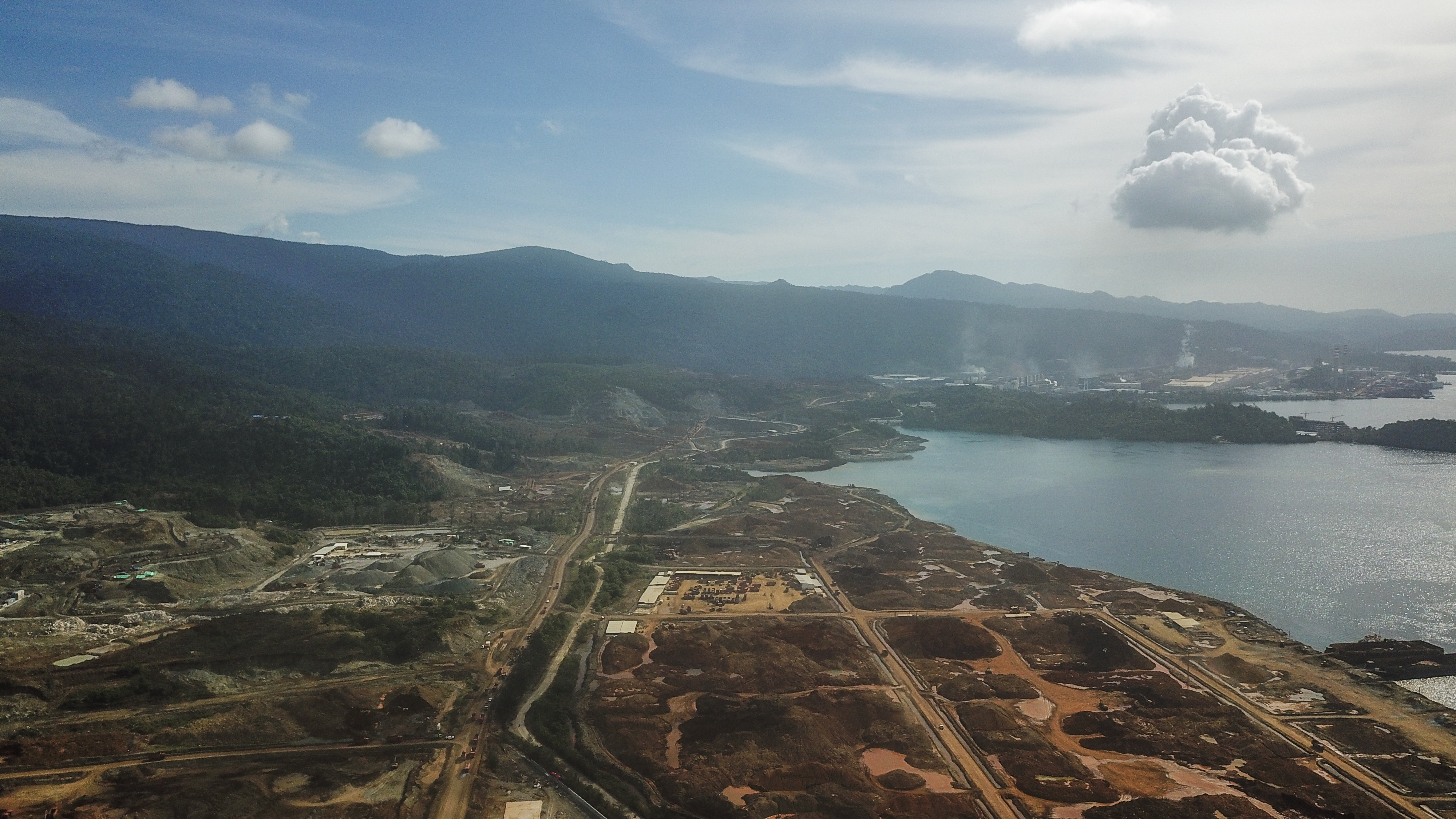
Summary: The Indonesia Weda Bay Industrial Park (IWIP) is a mega-nickel integrated mining and smelter project and the “first vertical, from mine mouth to finished products, integrated Electric Vehicle battery and stainless steel industry complex in the world”. It is located in Weda, Central Halmahera Regency, North Maluku, Indonesia. The IWIP is one of Indonesia’s strategic projects, designed to expand its domestic nickel processing capacity after the country banned unprocessed ore exports: close to the industrial park is the largest open-pit nickel mine in the world. To power the operations, a total of 11 coal plants have been built, and 3 more are under construction, despite the stated mission of the park to “minimise the emission of greenhouse gases”. It is a joint venture operated by a consortium of three Chinese companies.
Companies: The entity generally responsible for the development of the park is PT Weda Bay Industrial Park, whose ownership began in 2019 as Tsingshan Group (40% shareholding through its subsidiary Perlus Technology), Huayou Group (30%) and Zhenshi Group (30%). However, as of 2024, the ownership is apparently Tshingshan (46%), Zhenshi (24%) and Huayou (24%), while Chinese EV battery company Contemporary Amperex Technology (CATL) holds 6%.
Several companies operate within the park. PT Weda Bay Nickel, a JV between Tsingshan, French mining company Eramet, and Indonesian PT Antam, operates a large vertically integrated nickel mining and processing operation. Several other companies that operate are either wholly or majority subsidiaries of Tsingshan, Huayou, and Zhenshi. They include PT Yashi Indonesia Investment (a JV between Zhenshi, Tsingshan, and another Chinese company named Zhejiang Huajun Investment Co.), PT Huafei Nickel Cobalt (JV between Huayou, Tsingshan, and a Chinese company EVE) and PT Youshan Nickel Indonesia (a joint venture between Tsingshan and Chengtun, which acquired shares from Huayou), among others.
Financing: In 2022, a consortium of banks (China Development Bank, China Eximbank, Bank of China, Bank of Communications, the Industrial and Commercial Bank of China, China Everbright Bank, China CITIC Bank, Bank of Beijing, China Minsheng Bank (CMBC), China Construction Bank, China Zheshang Bank, and Ping An Bank) lent 7.48 billion RMB to Yashi Indonesia Investment, a subsidiary of Zhenshi with operations at Weda Bay.
Then in 2023, China Eximbank and ICBC led a group of 14 banks to provide a syndicated 8.4 billion RMB loan to PT Huafei Nickel Cobalt Co., Ltd, another operator at the park.
Project Impacts
- Environmental Impacts: Satellite imagery reveals extensive deforestation of more than 5,000 acres around the project area since the beginning of construction. Much of the surrounding areas are classified as Key Biological Areas by the International Union for the Conservation of Nature. Additionally, some of the nickel processed at the park comes from the Raja Ampat islands, widely recognised as both a terrestrial and marine biodiversity hotspot, and is additionally a protected area under Indonesian law in which mining is supposed to be heavily restricted. Under this law, a court revoked 4 licenses but still allows one major mine to keep operating in Raja Ampat.
- Water quality and flooding: Local residents have reported degraded water quality. Government tests confirmed that water from six nearby rivers all had nickel levels almost ten times the government limit. Other tests showed that all fish from those rivers now contained mercury and arsenic, and some had arsenic levels 23 times higher than when measured in 2007 in the area. In addition, flooding from nickel mines associated with the park has made many areas unsuitable for agriculture.
- Health risks: A third-party inspection has revealed that among those living near IWIP, 32% have unsafe blood mercury levels and 47% have unsafe blood arsenic levels. Data from the subprovincial Central Weda health authority, where the park is located, shows a more than 24-fold increase in acute respiratory infections from 2020 to 2023.
- Intimidation of residents and activists: Police and the military have reported intimidating residents who are resistant to selling land to IWIP or nearby mines. Authorities have charged many students and student groups with crimes or threatened them for raising criticisms against IWIP.
Last update: 2026-09-04